
No Space Under Your Sink? Here's How to Still Get a Quooker
It's one of the most common hesitations we hear: "I love the idea of a Quooker, but there's just no room under my sink." The good news is that this is rarely a dealbreaker — it usually just means choosing the right configuration for your kitchen.
How much space does a Quooker actually need?
Before assuming it won't fit, it's worth checking the real numbers, because they're smaller than most people expect:
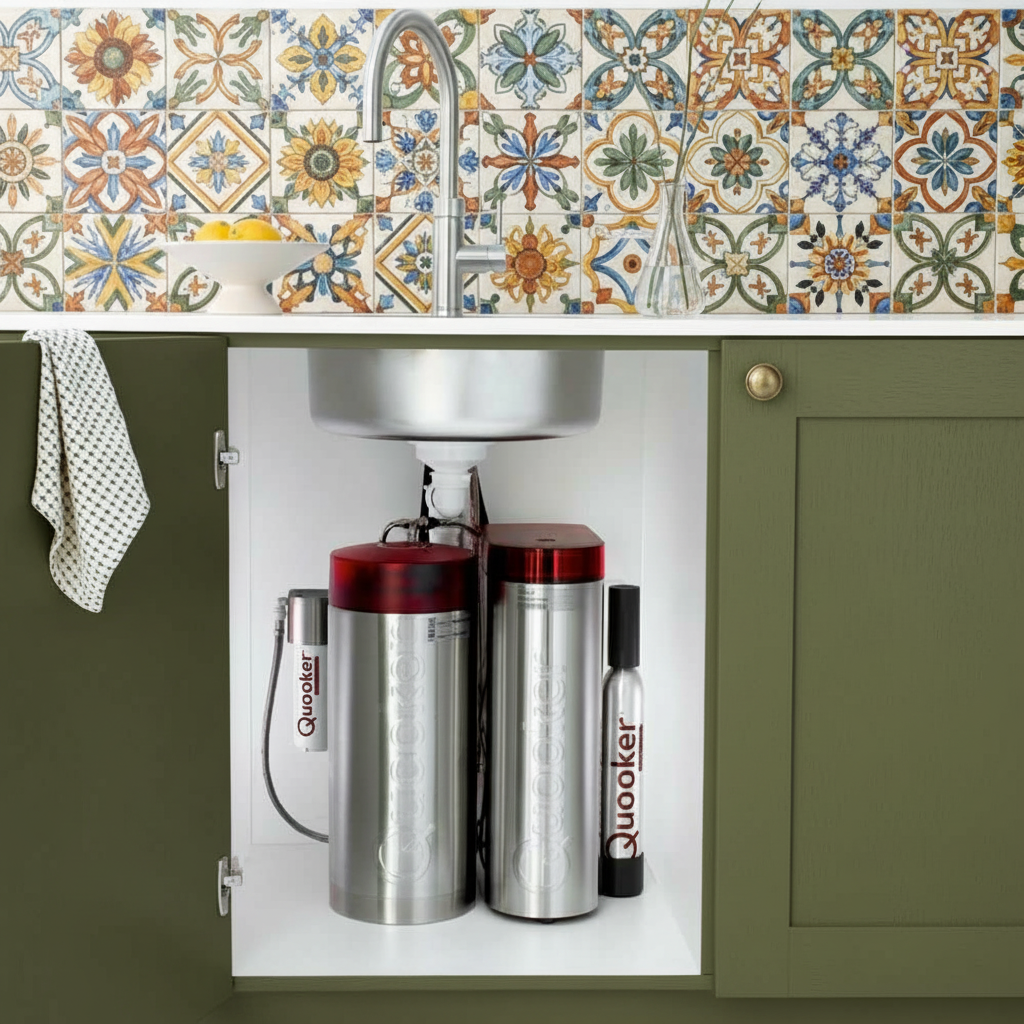
- PRO3 tank (the standard, most compact option): 47–50 cm in height, 15 cm in diameter — roughly the size of a large wine bottle.
- COMBI / COMBI+ tank: slightly larger at 49–58 cm in height, 20 cm in diameter.
- CUBE (if you also want chilled or sparkling water): 50 cm high, 22.3 cm wide, 34 cm deep.
For reference, a standard 600mm sink cupboard usually has enough room for a PRO3 tank alongside your regular plumbing and a waste bin. The tight spots are more often kitchens with a slimline cupboard, a lot of existing pipework, or a cupboard already packed with a waste disposal unit, water softener, and cleaning supplies.
What to do if it genuinely doesn't fit
If you've measured and it's still tight, you have more options than you might think:
1. Choose the PRO3 over the COMBI
If you're currently picturing the largest tank, switching to the compact PRO3 alone often solves the problem. It delivers 3 litres of boiling water instantly, which comfortably covers standard household use for tea, coffee, and cooking.
2. Reorganize, don't remove
Often the issue isn't lack of space, it's how the space is currently used. Relocating cleaning supplies to a different cupboard, or adding a slim shelf insert, can free up surprisingly enough room for a PRO3 tank.
3. Use an adjacent cupboard
The tank doesn't have to sit directly under the sink — it just needs to connect to the tap via hoses, which have some flexibility in length. If the cupboard next to your sink has more room, that's often a workable solution.
4. Consider the tank's exact footprint versus your cupboard
Sometimes a cupboard "feels" too small simply because of shelving or a fixed divider. Removing a shelf, or adjusting an adjustable one, can be enough to fit a PRO3 tank that otherwise wouldn't.
5. Extend the space through the cupboard floor
If your kitchen has skirting boards (plinths) at the base of the cabinets, we can often create an opening in the cupboard floor so the tank stands on the ground beneath it, hidden behind the skirting. This is one of our most effective solutions for tight spaces, since it uses space that's otherwise unused. It works particularly well when there's a reasonable gap behind the plinth — our installation team can assess this quickly from a photo. Without skirting boards, this option isn't usually practical, and one of the other space-saving approaches above is a better fit.
6. Adapt an existing drawer
If your sink cupboard has a drawer rather than open shelving, that doesn't have to rule out a Quooker either. We can often shorten the drawer neatly or create a cutout so the tank fits alongside it, without sacrificing the drawer's usable space entirely. This keeps your storage largely intact while still making room for the tank.

When it's worth a quick chat instead of guessing
Every kitchen is different, and measurements on paper don't always capture the reality of an oddly shaped cupboard or existing plumbing. Rather than assuming it won't work, it's usually faster to send us a photo or two of the space under your sink — we can often tell within minutes whether a standard installation will work, or whether a small adjustment (like a floor opening or drawer cutout) is needed.
Not sure if your kitchen has room for a Quooker? Send us a photo of your cupboard and we'll let you know what's possible — no obligation. Or browse our full range of Quooker taps to see which tank size fits your needs.